I am Valeria Villa, a fifth-year Ph.D. student at the California Institute of Technology working with Zachary E. Ross and Robert Clayton.
My research makes use of artificial intelligence (AI) and statistical methods. I use these tools to study regional seismicity, simulate earthquake sequences, and characterize the structure of the subsubsurface. I am grateful to be supported by an NSF Graduate Research Fellowship. At Caltech, I have also been funded by a Presidential Graduate Fellowship and GPS Faculty Fellowship.
I work on characterizing the dynamics of seismicity in the San Jacinto Fault Zone in Southern California from a point-process modeling perspective and earthquake simulations. My work relies on a detailed seismic catalog that I developed using deep-learning algorithms. Building on this work and that of others, I also focus on studying the mechanisms of swarms thought to be driven by natural fluids injected into faults. Additionally, I have a secondary focus on the sedimentary basins underlying mega-cities such as Los Angeles. I developed a method to integrate gravity measurements for identifying P-to-S converted phases in Receiver Functions. The advantage of this method is that it allows for the identification of the interface phases of interest without relying on signal coherence from neighboring stations. Instead, it directly models the gravity data, making it independent of other stations' measurements.
Research Topics
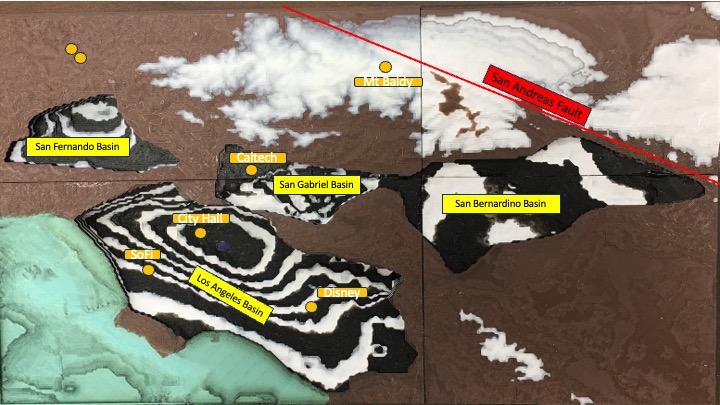
Los Angeles Basin Depth Model
I create 3D-printed models of geophysical research outputs, such as the depth structure of the Los Angeles Basin. My goal is to make complex scientific results more accessible by translating them into interactive and physical visualizations for a broader audience.
For information on the Los Angeles Basin model, click here.
Research Topics
The Dynamics of Seismicity of the San Jacinto Fault Zone
The region along and off the San Jacinto Fault Zone is a prolific area of
seismic activity. Between 2012 and 2022, there were around five
magnitude 4 earthquakes and numerous earthquake swarms. Several
of the swarms are assumed to have an aseismic driving process that
may relate to crustal fluid migration. Here we study the time-varying
seismicity background rates of independently triggered events from a
2012-2022 catalog built from deep learning algorithms. We apply the
newly developed method called deep Gaussian process â ETAS to
probabilistically model the time-variable background rate of aftershock
sequences and swarms in the area. The aftershock sequences show a
nearly constant background rate while the swarms exhibit a rich time-
varying seismicity background rate. In these latter cases, the swarms'
background rate evolution also demonstrates some degree of
aftershock triggering. The need for a time-varying background to
explain the swarm sequences continues to suggest a strong role of
aseismic forcing in this area. We are also able to better quantify the
aseismic factor with unprecedented detail of these not well-
understood sequences.
Earthquake Swarms in Southern California
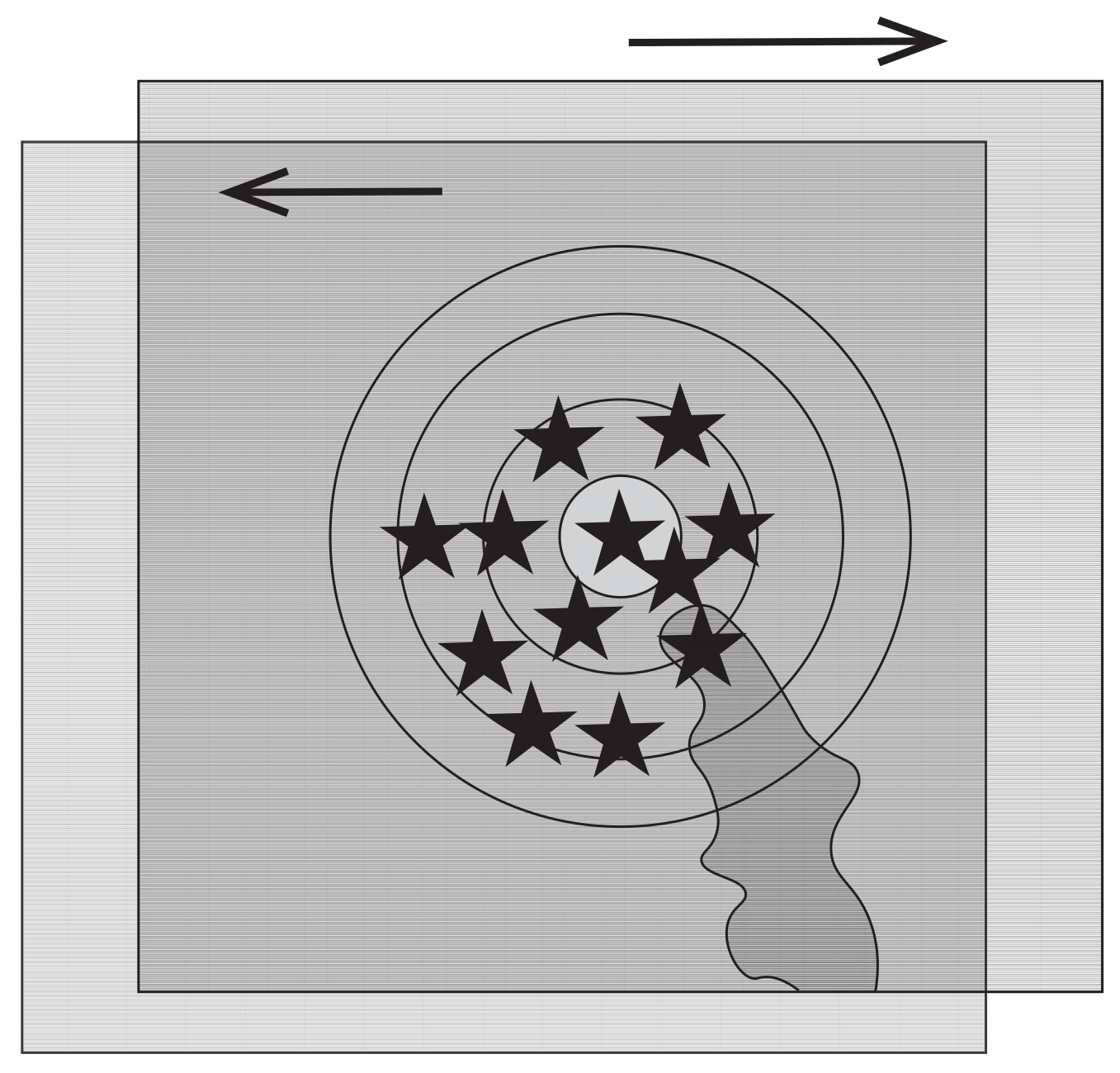
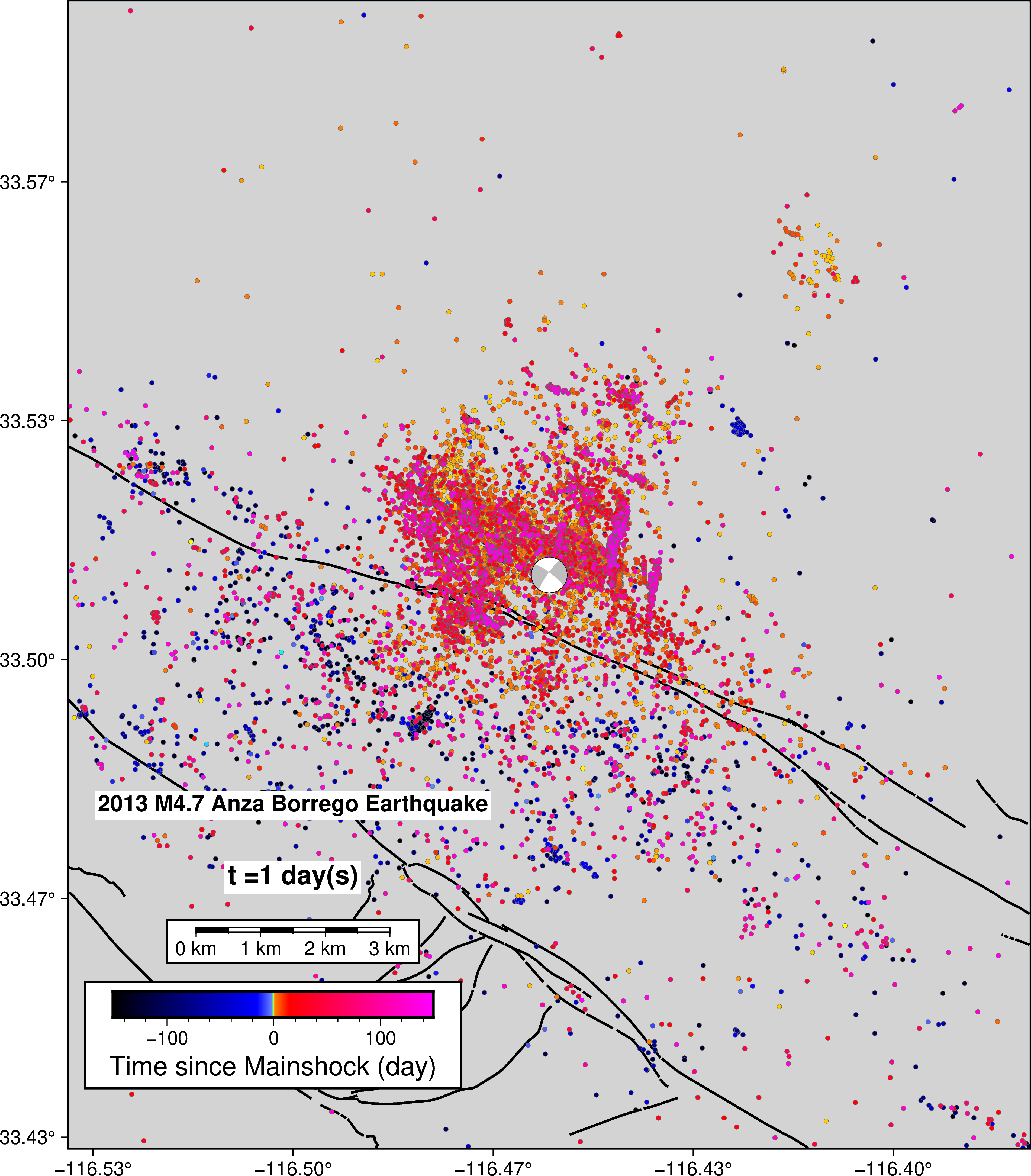
Recent observations of widespread ultra-slow diffusive swarms in southern California provide an opportunity to study the mechanical properties along these faults at depth. In particular, we focus on a four-year-long (2016-19) earthquake swarm, which delineated an approximately 4-km by 4-km fault near Cahuilla, Southern California. The swarm exhibits very slow diffusive migration consistent with natural fluid injections into a fault.
The Los Angeles Basin
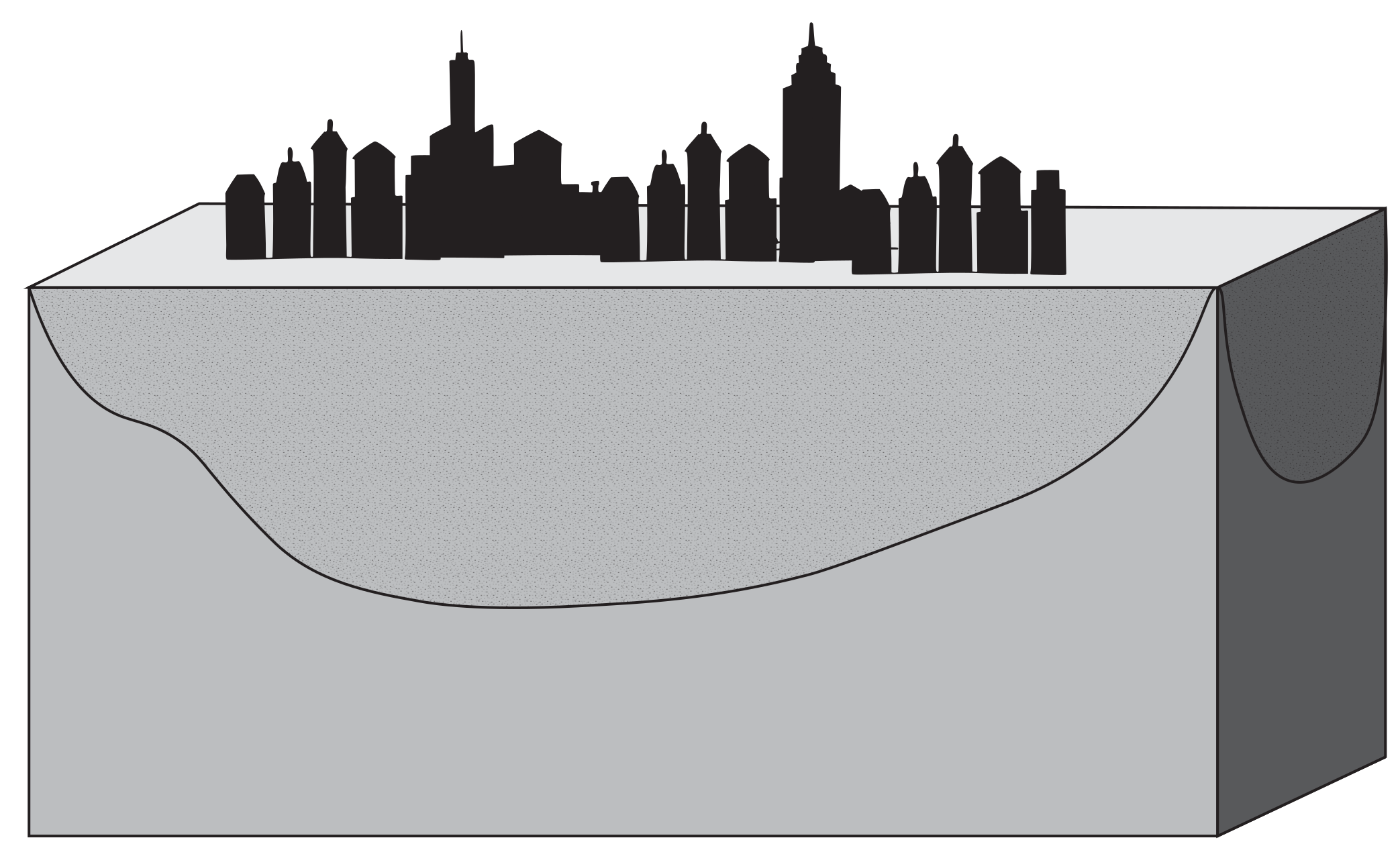
The sedimentary basin beneath the city of Los Angeles and surrounding area intensifies seismic ground motions and prolongs the duration of shaking experienced by major population centers and infrastructure in Southern California. Characterizing the basin's shape, which in this case, has been altered over the course of its complex tectonic evolution, is necessary for improving predictions of the strong motions of large earthquakes such as the potential Mw 8 on the southern San Andreas fault. Using a dataset acquired in fall 2022, when 273 seismic nodes were installed in the Los Angeles Basin (LAB), we applied a novel algorithm to identify the P-to-S conversion and related phases from the sediment-basement interface, intrasedimentary layers, and the Moho discontinuity in receiver functions. The survey included two linear arrays and a distributed set of shotgun stations, a configuration that typically challenges receiver function analysis due to phase incoherency among sparsely spaced stations. We addressed this limitation by integrating gravity measurements, allowing us to jointly interpret the multi-layer crustal structure. Our results reveal a narrow, oblong basin with a maximum depth approaching 10 km. Assuming isostatic equilibrium, we find that the Moho is uplifted beneath the basin by up to 45% when compared to the surrounding crust.
The Northern Los Angeles Basins
The structures of the northern Los Angeles basins are important to quantify the seismic hazard of the surrounding megacity, and in particular, the depth of basement is a critical factor in determining the ground shaking levels. In addition, the northern basins provide a mechanism to channel energy from a potential southern San Andreas earthquake into downtown Los Angeles. The Basin Amplification Seismic Investigation (BASIN) project conducted passive seismic surveys of the San Gabriel, Chino, and San Bernardino basins.
Despite their physical proximity, the subsurface structure of the northern basins is quite different in depth and shape, which provides insights about their formation. The San Gabriel Basin is the deepest basin with a maximum modeled depth of 3500 kilometers at the center. Another zone of significant depth is on the eastern edge of the basin. The Chino Basin, generally known as a groundwater basin, is characterized with shallow depths of about 1-1.5 km, and deepen to the north. The San Bernardino Basin, bounded between the San Jacinto fault (SJF) and San Andreas fault, is a semi-circular shaped basin with its deepest section edged closer to the SJF. Other notable depocenter of interest is north of the San Bernardino Basin and east of Chino Basin, which has a significant depth of 3.5 km. The fault locations with the basins have also affected their shape showing possible interactions with their formation.
Receiver Functions in the San Fernando Valley, California: Graph-Regularized Bayesian Approach for Gravity-Informed Mapping
The San Fernando Valley (SFV) in Southern California is a complex sedimentary basin whose shape strongly influences ground shaking. We develop a fully quantitative, probabilistic graph-regularized inference model that integrates both gravity and receiver function (RF) constraints and evaluate its ability to determine the basin's shape. The sediment-basement interface in single-station RFs is often difficult to interpret due to scattering and noise, which can render isolated stations unusable. By using RFs from a dense seismic array and incorporating gravity, we address the issue of non-uniqueness in converting the times of RF phases to layer thickness by comparing the predicted gravity to observations at each station. In areas where the density contrast may change, Bayesian inference with a graph Laplacian allows us to determine the effective density contrast by taking into account its neighbors' picks and densities. This method promotes spatial smoothness between neighboring stations, while preserving sharp contrasts in locations supported by the RF and gravity data. We applied this method to a dataset that was acquired in fall 2023, when 140 nodes were installed in the SFV. Our results show the deep Sylmar sub-basin, the San Fernando sub-basin, and the Leadwell high found in a previous study (Juárez-Zúñiga and Persaud, 2025), and our results also show good agreement with the industry seismic reflection profiles across the valley. This method demonstrates how to incorporate gravity with lateral density variations into receiver function interpretation to better map interfaces in the subsurface.
Villa, Valeria, Zachary E. Ross, Nadia Lapusta (2026). "Seismicity Dynamics of the SJFZ." In preparation.
Villa, Valeria, Zachary E. Ross, Nadia Lapusta (2026). "Time-Varying Background Rates of Swarms and Aftershock
Sequences in the San Jacinto Fault Zone in Southern California." In preparation.
Villa, Valeria, Clayton, Robert W., Persaud, Patricia, (2026), Receiver Functions in the San Fernando Valley, California: Graph-Regularized Bayesian Approach for Gravity-Informed Mapping. Submitted to JGR: Solid Earth, arXiv: Link
Villa, Valeria, Clayton, Robert W., (2026), Three-Dimensional Structure of the Los Angeles Basin and its Underlying Moho. Submitted to JGR: Solid Earth. essopenarchive: Link
Fan-Chi Lin, Robert W. Clayton, Heather A. Ford, Amir Allam, Konstantinos Gkogkas, Valeria Villa, HyeJeong Kim; LAB2022: A New Nodal Seismic Array Spanning the Los Angeles Basin. Seismological Research Letters 2025, link
Li, Yida, Clayton, Robert W., Villa, Valeria, (2025), Mapping the near-field scattered energy in sedimentary basins from ambient noise correlations, Geophysical Journal International, Volume 242, Issue 1, July 2025, Link
Villa, Valeria, Yida Li, Robert W. Clayton, Patricia Persaud, (2023), Three-Dimensional Basin Depth Map of the Northern Los Angeles from Gravity and Seismic Measurements, Journal of Geophysical Research: Solid Earth, 128, e2022JB025425, Link
Li, Yida, Villa, Valeria, Robert W. Clayton, Patricia Persaud, (2023), Shear Wave Velocities in the San Gabriel and San Bernardino Basins, California, Journal of Geophysical Research: Solid Earth, 128, e2023JB026488, Link
Villa, Valeria, Ramesh Singh. (2020) "Hydraulic fracturing operation for oil and gas production and
associated earthquake activities across the USA" Environ Earth Sci 79, 271,
doi:10.1007/s12665-020-09008-0